

Undergraduate Research
CNN School Face Recognition System
A team-built computer-vision system for recognizing uniformly dressed pupils in school surveillance footage.
View on GitHub
Computer Vision & School Safety
Project overview
Developed by a three-person undergraduate research team, this project explored how a convolutional neural network could support student safety and incident investigation at KNUST Basic School. The pipeline turns CCTV footage into labeled face data, trains a multiclass CNN, and applies the model to video frames for identity prediction.
Final-year undergraduate research completed by a team of three.
95.45%
Reported validation accuracy
Source: Thesis abstract
~20 GB
CCTV footage processed
Source: Thesis abstract
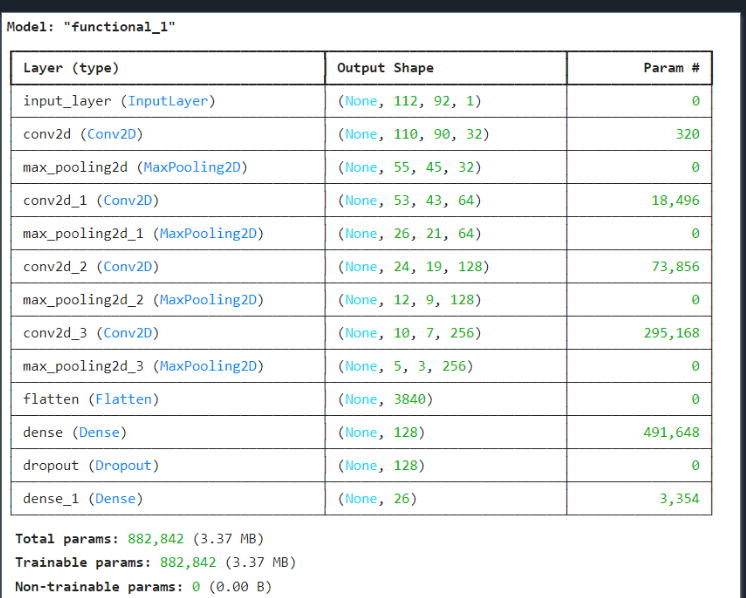
26
Identity classes
Source: Model architecture
882,842
Model parameters
Source: Keras model summary
The problem
Uniform school clothing makes visual identification from surveillance footage difficult, limiting how quickly schools can investigate bullying, vandalism, unauthorized access, and other safety incidents.
Approach
- 1
Process approximately 20 GB of CCTV footage and extract face images for individual pupil classes.
- 2
Resize faces to 112 × 92 pixels, convert them to grayscale, normalize the values, and augment the training data.
- 3
Train a four-block convolution and max-pooling network with a 128-unit dense layer, dropout, and a 26-class softmax output.
- 4
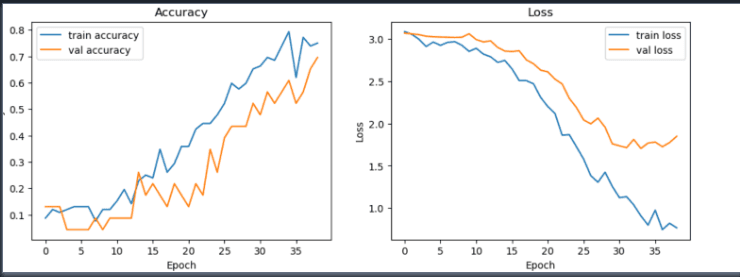
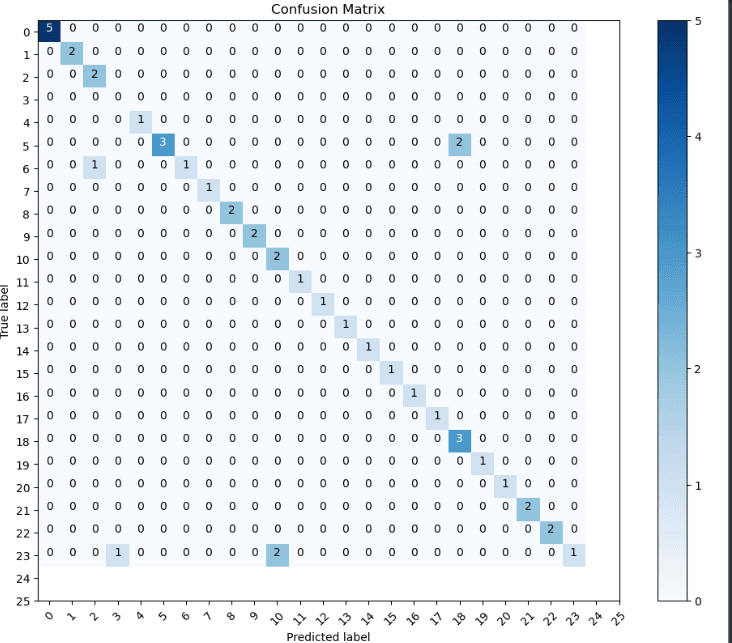
Evaluate predictions with accuracy and loss curves, a confusion matrix, and classification metrics.
- 5
Deploy the saved Keras model with OpenCV to detect faces, predict identities, and annotate video frame by frame.
Outcomes and insights
The thesis reports 95.45% validation accuracy and successful recognition when pupils were sufficiently close to the camera.
Testing identified camera distance and placement as important practical limits on recognition quality.
The work demonstrates an end-to-end research pipeline from CCTV data preparation through model training and video deployment.
The prototype provides a foundation for safer, carefully governed real-time monitoring in educational environments.
Research evidence
Selected technical figures from the thesis and implementation.
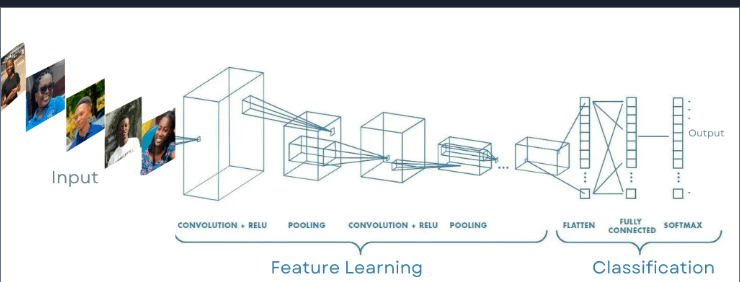
This public case study intentionally excludes identifiable pupil photographs and surveillance frames. Only technical figures and privacy-safe imagery are shown.